
miller welder manual
Miller welders, renowned for durability and innovation, require understanding their manuals for safe and efficient operation.
Locating your welder’s manual is crucial for troubleshooting and maximizing performance.
What is a Miller Welder?
Miller welders represent a cornerstone of welding technology, celebrated for their robust construction and cutting-edge features. Understanding the intricacies of your specific model, as detailed in the Miller welder manual, is paramount for optimal performance and safety. These machines range from portable units ideal for home projects to heavy-duty industrial solutions.
The manual serves as a comprehensive guide, outlining essential safety precautions, operational procedures, and troubleshooting steps. It details how to properly set up, operate, and maintain your welder, ensuring longevity and preventing potential hazards. Familiarizing yourself with the manual unlocks the full potential of your Miller welder.
History of Miller Electric Manufacturing Co.
Miller Electric Manufacturing Co., part of the ITW family alongside Hobart, Bernard, and Tregaskiss, boasts a rich history of welding innovation. While the company’s origins aren’t directly detailed in welder manuals, understanding its commitment to quality informs the thoroughness of those guides.
The manuals themselves reflect decades of expertise, evolving alongside technological advancements. They’ve transitioned from basic instruction sheets to comprehensive resources covering safety, operation, and maintenance. Accessing and diligently studying your Miller welder manual demonstrates respect for this legacy of engineering and ensures safe, effective welding practices.

Types of Miller Welders
Miller offers diverse welders – MIG, TIG, Stick, and Multi-Process – each with a specific manual detailing operation, safety, and troubleshooting procedures.
MIG Welders (Millermatic Series)
Millermatic series MIG welders, like the popular 211 model, demand careful manual review. The manual details setup for various metals and thicknesses, crucial for optimal weld quality.
Understanding wire feed speed adjustments, voltage settings, and gas flow rates, as outlined in the manual, prevents defects. Safety sections emphasize proper grounding, ventilation, and PPE. Troubleshooting guides address common issues like wire sticking or inconsistent arc starts.
Regularly consulting the manual ensures safe operation and extends the welder’s lifespan; Proper maintenance schedules, detailed within, are also vital for consistent performance. Ignoring the manual can lead to poor welds and potential hazards.
TIG Welders (Dynasty & Maxstar Series)
Dynasty and Maxstar TIG welders require meticulous attention to the operator’s manual due to their advanced features. The manual explains pulse welding parameters, AC balance control, and frequency settings for aluminum and other materials. Understanding these settings is key to achieving clean, precise welds. Safety precautions regarding high-frequency start and tungsten electrode handling are paramount.
Troubleshooting sections address issues like arc instability or tungsten contamination. Proper gas lens assembly and flow rate adjustments, detailed in the manual, are crucial. Regular manual review ensures optimal performance and longevity.
Stick Welders (Thunderbolt Series)
Thunderbolt stick welders, known for their simplicity, still necessitate careful review of the operator’s manual. It details proper electrode selection based on material type and thickness, alongside amperage settings for various rods. Safety warnings regarding electrical shock and fume exposure are critical. The manual guides users through troubleshooting common issues like poor arc starts or sticking electrodes.
Understanding polarity settings (DCEN/DCEP) is essential for successful welding. Proper grounding techniques, outlined in the manual, prevent hazards. Regular reference ensures safe and efficient operation of these robust machines.
Multi-Process Welders (Multimatic Series)
Multimatic series manuals are comprehensive, reflecting the machines’ versatility. They detail setup for MIG, TIG, and stick processes, including wire speed, gas flow rates, and amperage ranges. Understanding the synergic control features, explained in the manual, simplifies parameter setting. Safety sections emphasize proper ventilation and PPE for each process. Troubleshooting guides address issues specific to each welding mode.
The manual clarifies how to navigate the digital controls and utilize auto-set technologies. Proper maintenance schedules, outlined within, ensure longevity and optimal performance.

Key Features of Miller Welders
Miller welder manuals thoroughly explain features like Auto-Set, pulse welding, and synergic control, ensuring users maximize capabilities and achieve optimal welding results.
Auto-Set Technology
Miller’s Auto-Set technology, detailed within your welder’s manual, revolutionizes the welding process by automatically configuring welding parameters. This innovative feature drastically simplifies setup, particularly for beginners, by eliminating the guesswork involved in determining voltage, wire feed speed, and other critical settings. The manual guides users on how to utilize Auto-Set for various metals and thicknesses.
It ensures consistent, high-quality welds with minimal adjustments, reducing training costs and increasing productivity. Understanding how to properly leverage Auto-Set, as explained in the manual, is key to unlocking the full potential of your Miller welder and achieving professional-grade results effortlessly.
Pulse Welding Capabilities
Miller welders featuring pulse welding, as thoroughly explained in the welder’s manual, offer precise control over heat input and weld bead appearance. The manual details how pulse settings – peak current, background current, and pulse frequency – influence weld quality and penetration. This technology is particularly beneficial for welding thin materials, stainless steel, and aluminum, minimizing distortion and creating aesthetically pleasing welds.
Mastering pulse welding through the manual’s guidance allows for greater control, reduced spatter, and improved weld integrity. Understanding these settings unlocks advanced welding capabilities, enhancing both the quality and efficiency of your projects.

Synergic Control
Miller welders equipped with synergic control, as detailed in the manual, simplify the welding process by automatically adjusting parameters based on material type, thickness, and wire speed. The manual illustrates how to select pre-programmed synergic curves or create custom settings for optimal results. This feature reduces the learning curve for beginners and increases productivity for experienced welders.
The welder’s manual emphasizes understanding the relationship between these parameters to fine-tune welds. Synergic control ensures consistent weld quality, minimizing the need for constant adjustments and maximizing efficiency.
Digital Displays & Controls
Miller welder manuals thoroughly explain the functionality of digital displays and controls, crucial for precise welding. These displays provide real-time feedback on voltage, amperage, and wire feed speed, allowing for accurate adjustments. The manual details navigating the control panel, selecting welding processes, and utilizing advanced features like pulse welding.
Understanding the error codes displayed is also covered, aiding in troubleshooting. The manual stresses the importance of regularly checking the display for any anomalies, ensuring optimal performance and preventing potential issues during operation.

Popular Miller Welder Models
Miller’s Millermatic 211, Multimatic 220 AC/DC, and Maxstar 210 DX manuals detail specific settings and procedures for each model, ensuring optimal welding results.
Miller Millermatic 211
The Miller Millermatic 211 manual is an essential resource for both beginner and experienced welders. It provides detailed instructions on setup, operation, and maintenance of this popular MIG welder.
Specifically, the manual covers wire feeding adjustments, voltage control settings, and troubleshooting common issues like inconsistent arc length or poor weld quality.
Safety precautions are prominently featured, emphasizing proper grounding, ventilation, and personal protective equipment.
Understanding the manual’s guidance on gas flow rates and shielding gas selection is vital for achieving clean, strong welds.
Furthermore, it details the Auto-Set feature, simplifying parameter setup for various metal thicknesses. Regular reference to the manual ensures safe and efficient operation, maximizing the welder’s lifespan and performance.
Miller Multimatic 220 AC/DC
The Miller Multimatic 220 AC/DC welder’s manual is comprehensive, reflecting its multi-process capabilities. It details procedures for MIG, TIG, and Stick welding, including AC and DC TIG settings.
Users will find detailed explanations of synergic control, simplifying parameter adjustments for different materials and thicknesses.
The manual emphasizes safety protocols for each process, covering arc flash hazards and proper ventilation.
Troubleshooting sections address common issues like erratic arc behavior or difficulty starting an arc.
Understanding the manual’s guidance on pulse welding parameters unlocks advanced control and weld quality. It’s crucial for maximizing the welder’s versatility and achieving professional results.
Miller Maxstar 210 DX
The Miller Maxstar 210 DX welder manual focuses on its TIG and Stick welding prowess. It thoroughly explains the advanced TIG features, including pulse settings and waveform control, for precise arc manipulation. Safety sections detail proper electrode handling and gas shielding techniques.
The manual guides users through setting up and optimizing parameters for various metals like aluminum and stainless steel.
Troubleshooting covers issues like tungsten contamination and unstable arc starts; Understanding the manual’s instructions ensures optimal performance and weld quality, maximizing the machine’s capabilities for professional results.

Understanding Miller Welder Manuals
Miller welder manuals are essential resources, providing safety precautions, troubleshooting guides, and operational instructions for optimal performance and longevity of your equipment.

Locating Your Welder’s Manual
Finding your Miller welder’s manual is straightforward. Start by visiting the official Miller Welding website; they offer a comprehensive online library of manuals searchable by model number. Alternatively, many manuals are available as downloadable PDFs directly from the product pages. If you’ve misplaced the original paper copy, this digital resource is invaluable.
For older models, contacting Miller’s customer support can provide assistance in locating the correct documentation. Having the welder’s serial number readily available will expedite the process. Remember, accessing the manual ensures safe operation, proper maintenance, and effective troubleshooting, maximizing your welding experience with Miller equipment.
Safety Precautions & Warnings
Miller welder manuals prioritize safety, emphasizing crucial precautions before operation. Always wear appropriate personal protective equipment (PPE), including a welding helmet, gloves, and fire-resistant clothing. Ensure adequate ventilation to avoid inhaling fumes. The manual details electrical shock hazards and grounding procedures – strictly adhere to these guidelines.
Pay close attention to warnings regarding flammable materials and hot surfaces. Never weld on containers that have held combustible substances. Regularly inspect equipment for damage and report any issues immediately. Following these safety measures, detailed within the manual, is paramount for preventing accidents and ensuring a secure welding environment.
Troubleshooting Common Issues
Miller welder manuals offer comprehensive troubleshooting guides for frequent problems. Common issues include inconsistent arc starts, poor weld quality, and machine failures. The manual details steps to diagnose these, often starting with checking power supply, gas flow, and electrode condition.
It provides solutions like cleaning connections, replacing consumables, or adjusting settings. If problems persist, the manual directs users to contact authorized service centers. Utilizing these troubleshooting steps can minimize downtime and ensure efficient repairs, extending the welder’s lifespan and maintaining optimal performance.
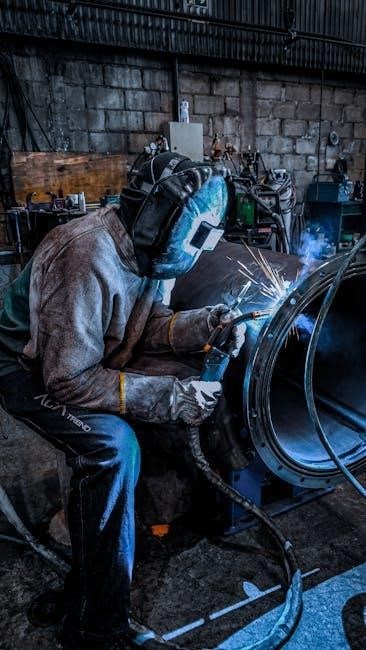
Miller Welder Maintenance
Miller welder manuals emphasize regular cleaning, inspection, and consumable parts replacement for optimal performance.
Following these guidelines ensures longevity and reliable operation.
Cleaning & Inspection
Miller welder manuals consistently highlight the importance of routine cleaning and thorough inspections. Before each use, carefully examine the power cable for any damage, ensuring the connections are secure and free from corrosion. Regularly remove any metal debris or spatter from the welding area, particularly around the nozzle and contact tip.
Inspect the gas hoses for leaks or cracks, and verify the gas flow is consistent. A clean welder operates more efficiently and reduces the risk of malfunctions. Following the manual’s cleaning schedule will extend the life of your equipment and maintain weld quality. Don’t neglect internal components either; periodic checks are vital.
Consumable Parts Replacement
Miller welder manuals detail specific intervals for replacing consumable parts, crucial for maintaining optimal welding performance. These parts, including contact tips, nozzles, gas diffusers, and electrodes, wear down with use and impact weld quality. Regularly check these components for signs of wear, such as pitting, erosion, or damage.
The manual will specify the correct replacement parts for your specific Miller model. Using genuine Miller parts ensures compatibility and reliability. Prompt replacement prevents contamination and ensures consistent arc stability, ultimately extending the lifespan of your welding equipment and improving results.
Gas & Shielding Considerations
Miller welder manuals emphasize the importance of proper shielding gas selection and flow rates for optimal weld quality. The manual will specify the recommended gas type – argon, helium, or mixtures – based on the material being welded and the welding process used (MIG, TIG, etc.).
Maintaining the correct gas flow rate, typically measured in cubic feet per hour (CFH), is vital for adequate shielding. Insufficient gas leads to porosity, while excessive flow can cause turbulence. Regularly inspect gas lines for leaks and ensure the gas cylinder is properly secured.

Miller Welder Rebates & Promotions
Miller frequently offers “Build with Blue” rebates, often including bonus rebates when paired with accessories or Hobart filler metals—check your manual!
Build with Blue Rebates
Miller Electric Manufacturing consistently runs the “Build with Blue” rebate program, designed to incentivize customers and boost sales on their welding equipment. These rebates aren’t just on the welders themselves; a significant component involves adding select Miller accessories or Hobart filler metals to your purchase.
Always consult your welder’s manual to ensure compatibility of any accessories you intend to purchase for rebate eligibility. The program details, including qualifying models and rebate amounts, are frequently updated, so checking the official Miller website is essential. Understanding the terms and conditions, often detailed within the rebate form, will prevent any issues during the claim process.
Current Offers on Select Models
Miller frequently offers promotions on specific welder models, often bundled with accessories or extended warranties. The Millermatic 211, Multimatic 220 AC/DC, and Maxstar 210 DX are often featured in these deals. Before purchasing, always verify the current offers on the Miller website, as promotions change regularly.
Referencing your welder’s manual can help determine if any bundled accessories are compatible with your specific needs. Understanding the welder’s capabilities, as outlined in the manual, ensures you’re maximizing the value of any promotional offers. Carefully review the terms and conditions of each promotion.

Engine-Driven Miller Welders
Miller’s Bobcat and Trailblazer series require understanding the manual for proper engine maintenance and welding output when operating remotely.
Bobcat Series
Miller’s Bobcat series of engine-driven welders offers portability and versatility, making them ideal for fieldwork. However, maximizing their potential and ensuring longevity hinges on diligent adherence to the owner’s manual. The manual details crucial information regarding engine maintenance – oil changes, air filter cleaning, and fuel system upkeep – vital for consistent performance.
Furthermore, it outlines proper welding procedure selection, amperage settings, and safety protocols specific to the Bobcat model. Understanding the manual’s troubleshooting section can resolve common issues quickly, minimizing downtime. Always consult the manual before attempting any repairs or modifications to guarantee safe and effective operation of your Bobcat welder.
Trailblazer Series
Miller’s Trailblazer engine-driven welders are built for demanding jobsites, and their manuals are essential guides for optimal performance. The manual provides detailed instructions on operating the engine, including fuel requirements and recommended maintenance schedules – crucial for reliability in remote locations. It also covers welding process selection, explaining how to achieve the best results with various materials and techniques.
Safety is paramount; the manual outlines critical precautions to prevent accidents and ensure operator well-being. Familiarizing yourself with the troubleshooting section can quickly address common issues, reducing downtime. Always refer to your Trailblazer’s manual for specific guidance and maintain its peak condition.
Power Requirements (10kW Output)
Miller engine-driven welders, like the Bobcat and Trailblazer series, require a minimum of 10,000 Watt (10kW) output for full operational capacity. Your welder’s manual details specific power input requirements, ensuring stable performance and preventing damage. It clarifies generator compatibility, emphasizing the need for sufficient amperage and voltage to support welding processes.
Understanding these specifications is vital for proper setup and avoiding power-related issues. The manual also addresses potential problems caused by inadequate power sources, offering troubleshooting steps. Always consult the manual before connecting to a power source to guarantee safe and efficient operation.